Dangermuffin Returns to Its Roots
When Dangermuffin last visited Washington in 2018, the South Carolina band was touring behind Heritage and performing as an expanded ensemble.
A great deal has changed since then.
Dangermuffin gradually reduced its touring schedule before the pandemic brought live music to a standstill. Singer and guitarist Dan Lotti and guitarist Mike Sivilli branched into film scoring, music supervision, and production, while drummer/bassist Steven Sandifer remained active in Charleston’s music community, performing with several roots and world-music projects and developing Charleston Heritage Entertainment. Collectively, the band members pursued lives and creative opportunities outside the familiar cycle of recording and touring.
Eventually, however, Dangermuffin began to miss the community it had built on the road.
The band returned in 2024 with a self-titled album recorded at Echo Mountain, a converted church and celebrated recording studio in Asheville. The record expanded Dangermuffin’s familiar mixture of roots rock, Americana, reggae, and improvisational music while exploring themes of light, healing, growth, memory, and mortality.
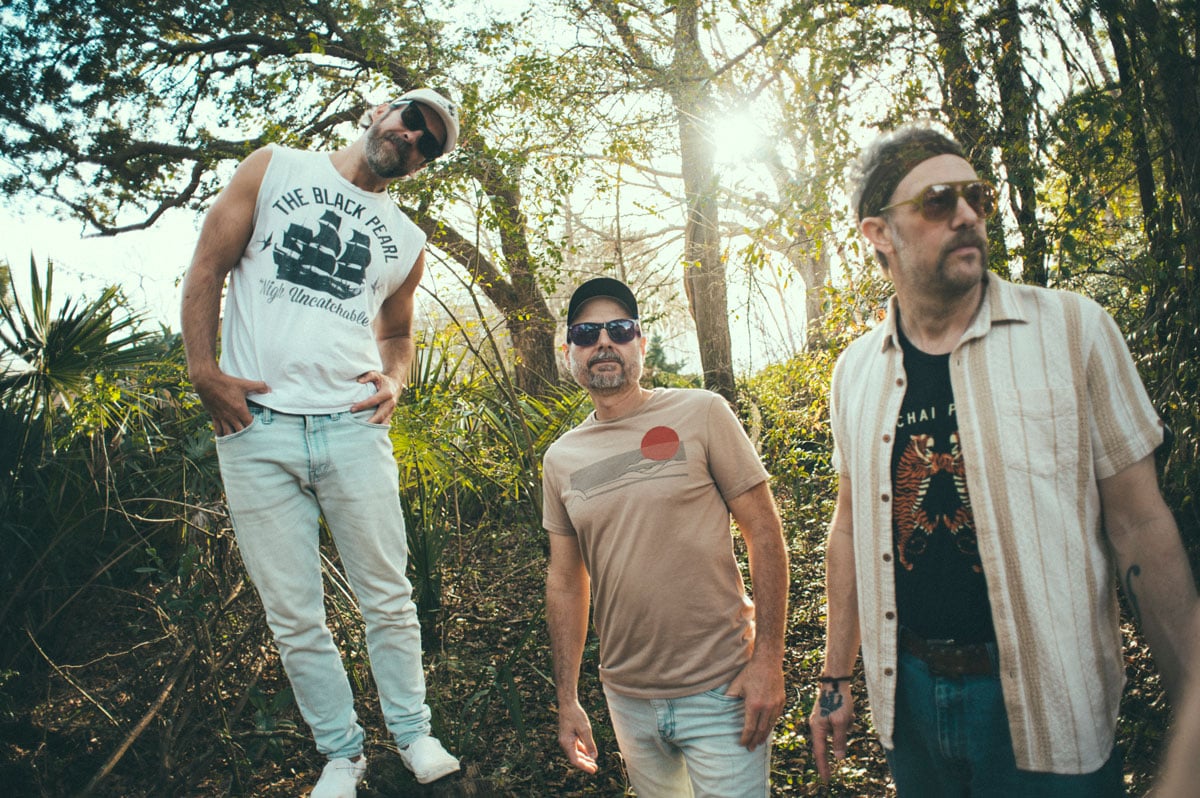
Now Lotti, Sivilli, and Sandifer have pared Dangermuffin back to its original trio configuration. Sandifer is again behind the drum kit, while Lotti uses a specially modified guitar to provide rhythm, melody, and low-end frequencies simultaneously.
Dangermuffin returns to Washington on Aug. 13 for a performance at The Hamilton Live. The show begins at 8 pm, with doors opening at 6:30pm. Tickets range from $31.18 to $42.52. (The Hamilton Live)
Ahead of the show, Parklife DC’s Ari Strauss spoke with Lotti about the band’s extended absence, its return to the original trio, the creative value of leaving a few screws loose, and music’s capacity to provide healing during difficult times. The following interview has been edited for length and clarity.
___
Ari Strauss: Dangermuffin last played Washington in 2018 while touring behind Heritage. The band then stepped away for several years before returning with the self-titled album in 2024. What were the members doing during that extended break, and what made the time feel right to begin making music together again?
Dan Lotti: Most of it had to do with COVID. We had slowed down a little before then, but obviously no one could tour or do much of anything during that stretch.
Mike Sivilli, our guitar player, and I also started working in film. We began scoring films and doing music supervision, and we became partners in a film production company. We were reading scripts, and our perspective on creating started to evolve around 2019. That was super fun for us, but it also changed our capacity for touring.
Ultimately, we got back on the road because we missed all the connections, friends, and extended family we had known for so long. We missed playing. It has been nice to return and try to find a balance with everything, playing when we can.
We just did a little Wisconsin run, and it’s crazy to hear that we haven’t been to DC since 2018. It’s amazing how time flies.
AS: That 2018 show at Hill Country Barbecue was one of the first concerts I photographed. I later caught up with you in Eugene, Oregon, before the Northwest String Summit.
DL: This is all coming back to me now. I remember those DC photos. Those were good shots!
AS: Your self-titled album has been described as a season of “synergy and rediscovery.” What were you rediscovering about Dangermuffin while making it?
DL: It was the natural impulse to create, connect, and continue building what we had. At the time, it felt like a reinvigoration to be able to reconnect.
Honestly, I think it is one of our best records, especially sonically. We recorded it at Echo Mountain in Asheville, which is a really nice studio where we had always wanted to work.
It was good to create something and keep the ball rolling. It’s funny talking about it now because we’re halfway through 2026, and that album already feels like it was a while ago in my life.
AS: Is another album beginning to take shape?
DL: There have been some changes for me personally. I was living in Nashville, and now I’m back in Charleston, South Carolina, spending a lot of time on Folly Beach, where the band started. There is definitely a lot of inspiration there. Seeds are being planted for another record. I think it is probably time to get after it again.
AS: You mentioned Echo Mountain, which is housed in a former church. How did the character of that space influence the album?
DL: It is an amazing place. The highlight for us was the number of influential albums that have been recorded there.
We came up as big Band of Horses fans, and they did some recording at Echo Mountain. The Avett Brothers made records there, and My Morning Jacket did some work there. A lot of those albums were really important to us.
The pedigree of playing in that room definitely inspired us. It was a full-circle moment.
Watch Dangermuffin perform “I Will Never Forget,” a song from the band’s 2024 self-titled album recorded at Echo Mountain in Asheville. (Video via YouTube)
AS: Dangermuffin combines carefully constructed songwriting with sections that can expand during live performances. When you develop a song, where does composition end and improvisation begin?
DL: I see the creation of a song and the improvisational aspect as two different parts of the journey.
I’ve learned to look at songwriting like ordering a piece of furniture that arrives in a box. You have to assemble all the parts, but the instructions might tell you not to tighten certain screws completely because you need some wiggle room for everything to come together.
That is an important aspect of being in a band, and really of life in general. It is a metaphor for creating anything, whether we’re talking about photos, relationships, or songs. You have to recognize that you are seeking synergy.
I write a lot of the lyrics, and many of the seeds for songs start with me, but it depends on the song. An idea might begin with a groove from Steven, or Mikey might bring in a guitar riff. We’ve written collaboratively over the years.
As a songwriter, I might have a particular vision for how something should come together. When that doesn’t happen, it is important to release the preconceived idea and allow space for the creation to reveal what it is going to be.
You have to get out of the song’s way a little and let it come together. When you are a solo songwriter, you can make everything exactly as you see fit. When you are in a band, you are participating in a collaborative process.
AS: How does that process carry over to the stage?
DL: We build arranged grooves into the songs that leave space for the dynamics to develop as we feel the energy in the room.
Mikey never plays the same guitar part twice. Obviously, he plays the main licks, but he has never performed something like “Moonscapes” note for note. The solo is always different.
We played in Madison recently, and you could feel something happening in the room. We might decide to keep a section going and let it build based on that energy.
The culminating point is that it is always interactive, whether it is happening among the musicians or between the band and the community gathered for the show. It is always a collaborative experience.
AS: When you write, do the words or the melody usually come first?
DL: I write from melody. Melody is my favorite part of songs.
For me, it isn’t about the intricacy of the chord structure or the complexity of the music. If you can take a simple chord arrangement and create a melody that moves you and stays with you, that is the best part of a song.
Sometimes I’ll hear an idea while falling asleep, or I’ll be playing guitar without thinking much about it. In my better moments, I’m hearing the melody.
Without getting too “woo-woo,” I do think you can become a conduit. There is a muse and an energy involved. Your job as an artist, songwriter, or musician is to hear those little seeds and help them grow.
AS: Dangermuffin originally built its following through extensive touring and festival appearances, but its streaming audience has grown substantially in recent years. Are you meeting younger or first-time fans who discovered the band online?
DL: Absolutely.
Early on, we were a “get in the van and go everywhere” kind of band. We played a lot of shows for not a lot of people. Satellite radio play was a big deal for us at the time, but the way people consume music has obviously changed considerably.
Spotify’s algorithm has been helpful to us. There are plenty of reasons to scrutinize Spotify, and I think we all know that. But it can also be good for independent bands because you are opening your music to the world. When people start to connect with it, it spreads.
We hadn’t played Wisconsin in probably 15 years, and it wasn’t as though we had toured that area heavily before. Yet we were selling tickets in those markets. People told us they drove from Chicago or other cities to be there and explained what the music meant to them.
It is beautiful to think about all the people we have met whom we never would have known if not for the music we were making. Looking back on everywhere we’ve been, that is the best part.
AS: When I saw Dangermuffin in 2018, Adam Williams was on drums while Steven played percussion. The two had especially strong chemistry, including their call-and-response solos during “Lady of Fire.” What is Adam doing now?
DL: Adam has been doing heavier touring with several reggae bands. That includes working with H.R., the original singer and creator of Bad Brains, who is a legend.
Adam has been doing great and has been very successful. We keep in touch.
Back then, we were working enough to offer other musicians an opportunity to come out and be part of the band. We simply aren’t touring as much now, so it isn’t as much of an opportunity for sustenance for our talented friends.
We scaled down and returned to the trio, with Steven back on drums. We also perform as an acoustic trio.
That feels like our identity. We love Adam. We love Andrew Hendryx, who played mandolin on the last record, and Marcus Brazier, who drummed on Heritage. We enjoyed our time with everyone, but where we are now is back to the roots and back to the trio.
AS: Andrew contributed to the latest record, but he isn’t currently touring with the band?
DL: That’s correct. Andrew contributed amazing creative energy to the album. I love that we have that record because his involvement makes it unique and special.
But our creative capacities have expanded beyond being solely a touring band. We’re lucky enough to work on other projects, and we don’t have enough touring work to offer musicians who need to make their living on the road.
I wish we could have a 10-piece band with everything, but that just isn’t what we’re doing right now.
AS: In the trio configuration, Steven plays drums during the electric shows. Without a bassist onstage, how are you creating the low end?
DL: I play a Godin A6 Ultra that sends separate guitar and bass signals. I installed a pickup that drops only the two lowest strings, the E and A, by an octave. By palm-muting those strings while strumming, I can cover the low end and rhythm guitar at the same time.
I’m not playing intricate bass lines, but the setup gives the trio a fuller sound without changing its character. We’ve worked with bass players before, but this approach has become part of Dangermuffin’s sonic fingerprint.
Watch Dangermuffin perform Lady of Fire live at StageOne via YouTube)
AS: The Hamilton can function as an intimate listening room, but it also has space for the audience to get up and dance. How will you approach the show?
DL: We’re definitely going to bring some energy.
We always walk that line based on whatever people want to do. We’re never going to be the band that tells people to stand up or behave a certain way. We’re very laid back about it.
If people want to sit and listen, we can respond to that. Even with our electric setup, a lower noise floor allows us to express the music intimately.
If there is energy in the room, however, we will meet that energy for sure.
AS: For someone in Washington who knows Dangermuffin’s name but hasn’t seen you perform, what do you hope they understand about the band by the end of the show that they cannot get from the recordings?
DL: I want them to feel that we’re coming through to celebrate life, music, and the songs we have been creating for decades.
Our hope is to help whoever is there have some fun and forget about the heavy stuff for the 90 minutes or two hours that we’re playing. Hopefully, they can find some healing in what we are doing.
Music saved my life a long time ago, and sometimes I forget that. It healed me.
There are always heavy things happening in life. But when you get onstage and have the opportunity to sing and play, it is a healing experience. It is always that for me.
My hope is that the feeling resonates outward to everyone there in whatever way it can for each person.
__
Dangermuffin performs at The Hamilton Live, on Thursday, Aug. 13.
Dangermuffin
The Hamilton Live
Thursday, August 13
Doors @ 6:30pm
Show @ 8pm
$31.18 – $42.52
All ages