Early in a recent performance at The Anthem in Washington, DC, David Byrne recalled growing up not too far away and attending school in suburban Baltimore. Not an unhappy (but shy) boy in high school, David shared class with a girl who always seemed to be happy all the time. Suspecting she may hold some knowledge that he did not, he finally asked her how it was that she was so happy all of the time.
“LSD,” the girl told him. She would use the drug in the nearby field outside of a Yoo-hoo chocolate drink factory. The revelation inspired the song “And She Was,” a 1985 song that David composed for Talking Heads. The sold-out audience at The Anthem cheered references to David’s local roots and entered their own state of bliss upon hearing the song live.
In the first of two nights at The Anthem on Sept. 27, David Byrne didn’t simply pick up a guitar and play his songs, however. He channeled their energies into an upbeat presentation like a fatherly arts wizard, creating at times a powerful call to freedom of expression. Throughout his show, David was inquisitive and open-minded, and he approached his songs and the topics that they touched upon with a sense of wonder and kindness.
Watch the official music video for “And She Was” by Talking Heads on YouTube:
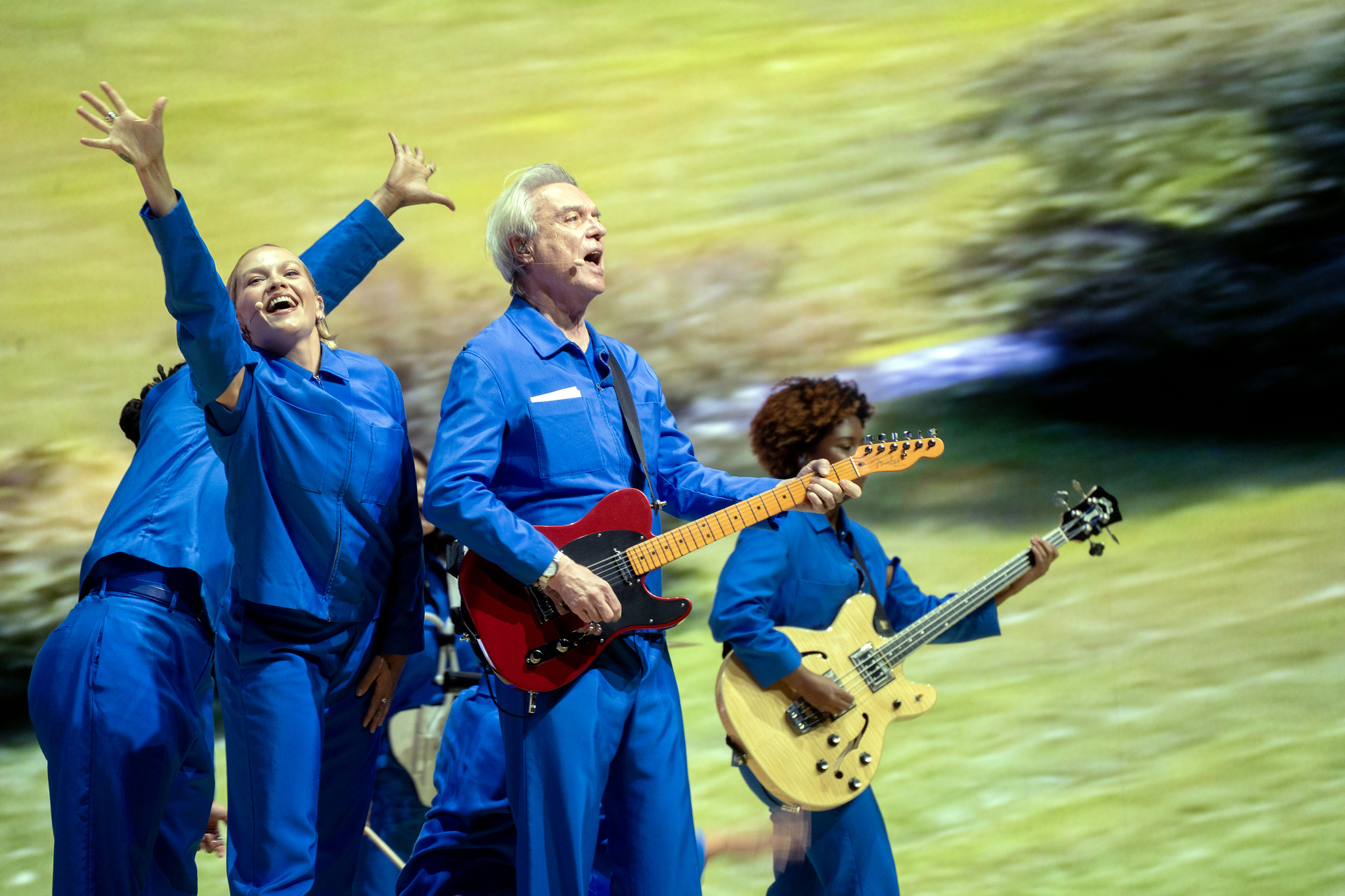
In presenting numbers from his new album Who Is the Sky as well as a healthy dose of tracks from his old band Talking Heads, David also led a group of 13 musicians who circled, snaked, and followed him in the free-flowing manner of his American Utopia Tour of 2018. In that tour, Davi conceived that the musicians of his band wouldn’t stand moored to fixed stations but instead they would move about the stage to accentuate the music. The Who Is the Sky Tour continues that modus operandi, granting David the power to call upon players, who expertly engage their instruments or dance and mime along to the music, as required.
Nowhere was this more effective than in the performance of a totally new and unrecorded song lyrically addressing the idea of wearing your heart on your sleeve or specifically wearing your ideals on your t-shirt. The jaunty, happy song was a hit with the audience, and the “T-shirt song” has generated a great deal of anticipation online that David may soon release it. (David made clever use of his screens to present supposed T-shirt slogans but perhaps none won as much applause at The Anthem as “Make America Gay Again.”)
David dedicated the first third of the concert mostly to Talking Heads songs and the crowd-pleasing T-shirt number, giving an audience that already clearly loved the man every opportunity to eat up everything he had to offer. He began the show with “Heaven” (1979) by Talking Heads and the crowd roared in approval to the rarely performed “Houses in Motion” (1981) soon afterward. After “T-Shirt,” David broke out two of the most enduring Talking Heads tunes: “(Nothing But) Flowers” (1988) and “This Must Be the Place (Naive Melody)” (1983), one of the greatest songs ever written. (No other composition will make the listener feel so grounded and happy as this song.)
This paved the way for David to introduce the audience to five tracks from Who Is the Sky, released about a month ago via Matador. These very good new songs were produced with the assistance of Ghost Train Orchestra, a New York City jazz ensemble that also lent personnel to the touring band of 13 people who appeared and played on cue. While the familiar material eased the audience into these new songs, they are very good and make wonderful use of David’s proclivity for intellectual thoughtfulness. Actually, David introduced the album’s “Everyone Laughs” early in the show and then settled into Who Is the Sky with “What Is the Reason for It?” in the middle.
Watch the official music video for “What Is the Reason for It?” by David Byrne featuring Hayley Williams on YouTube:
David closed the string of Who Is the Sky tracks with “My Apartment Is My Friend,” a personal favorite from the new record. The song anthropomorphizes David’s domicile in New York City, an idea that occurred to him during pandemic lockdowns where he could experience low feelings yet still feel the warm embrace of his home. I really loved it.
In the final stretch of the show, David truly killed it with exciting arrangements of classics “Psycho Killer” (1977), a tune David thrillingly resurrected with some clever shadow play after a long pause; “Life During Wartime” (1979), a counter-establishment tune that came alive with startling relevance for today’s world; and “Once in a Lifetime” (1981), perhaps the song most famously associated with David, at least as measured by memes.
The show concluded wonderfully with a two-song encore: “Everybody’s Coming to My House” from American Utopia and Talking Heads’ “Burning Down the House” (1983), a final opportunity for the audience to enthusiastically sing along.
David Byrne began his professional career in Manhattan as part of the punk scene that emerged around the CBGBs music club, and the punk philosophies of brotherhood and rejecting authority still very much run through his veins. David puts his mind to these ideals, and the results are always undeniably authentic and charming. At The Anthem, he paraphrased John Cameron Mitchell, calling love a very punk thing, and in doing so, David was endorsing a sort of resistance but also reminding us what it is to be a human being.
He is a man who follows his heart and makes powerful art from it, and we as his admirers are richer for it.
Here are some photos of David Byrne performing live at The Anthem in DC on Sept. 27, 2025. All pictures by Mickey McCarter.