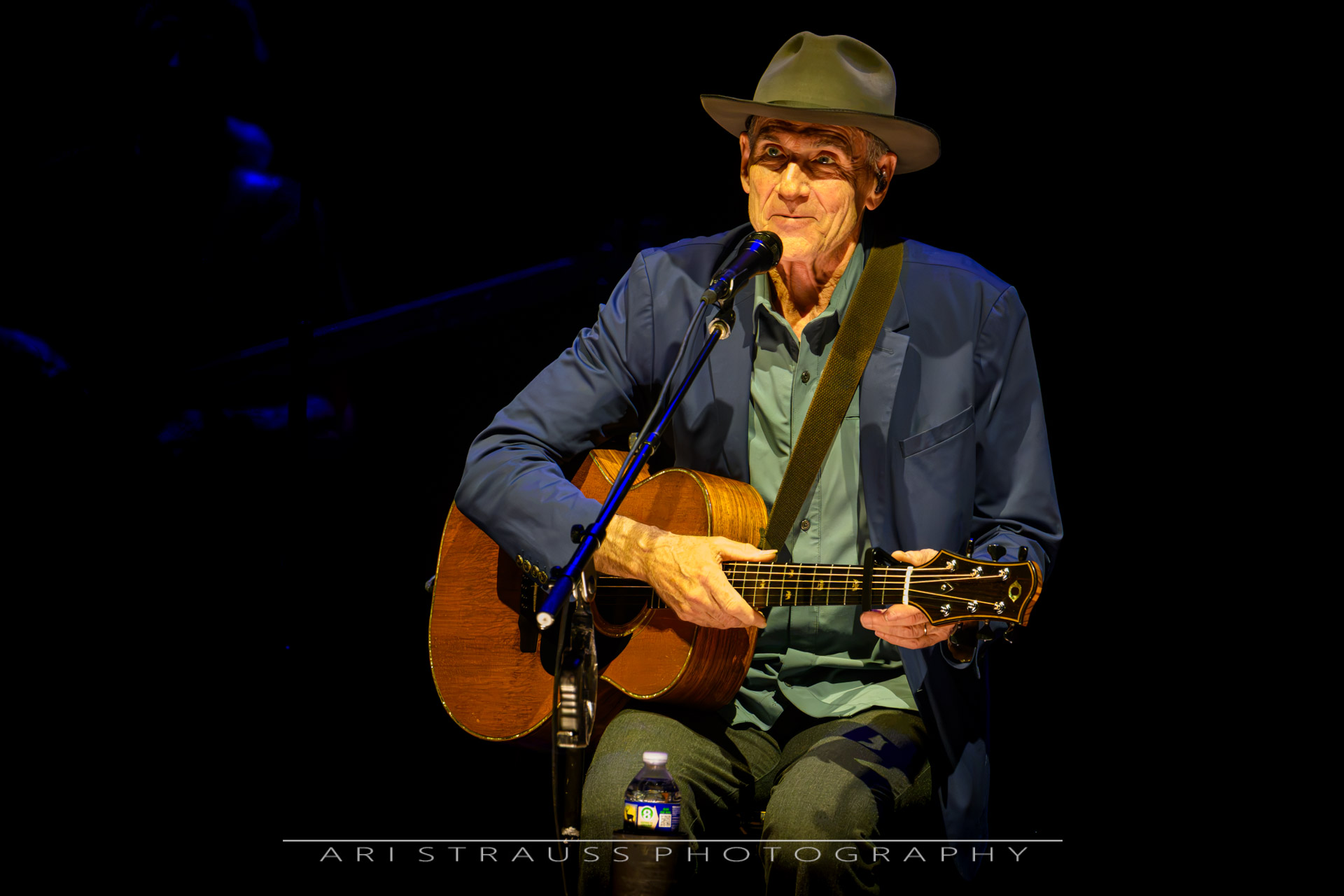
A line of severe weather pushed James Taylor’s Sunday night return to Wolf Trap back by roughly 20 minutes, a delay made largely out of consideration for the thousands of people sitting exposed on the lawn. By the time Taylor and his All-Star Band finally walked onstage, the rain had not entirely given up, but neither had the crowd of dedicated James Taylor fans. The pavilion was full, the lawn remained populated, and there was remarkably little sense that anyone’s enthusiasm had been washed away.
I joked to the other photographer standing next to me, “Wouldn’t it be hilarious if he open the show with “Fire and Rain?”
He did not.
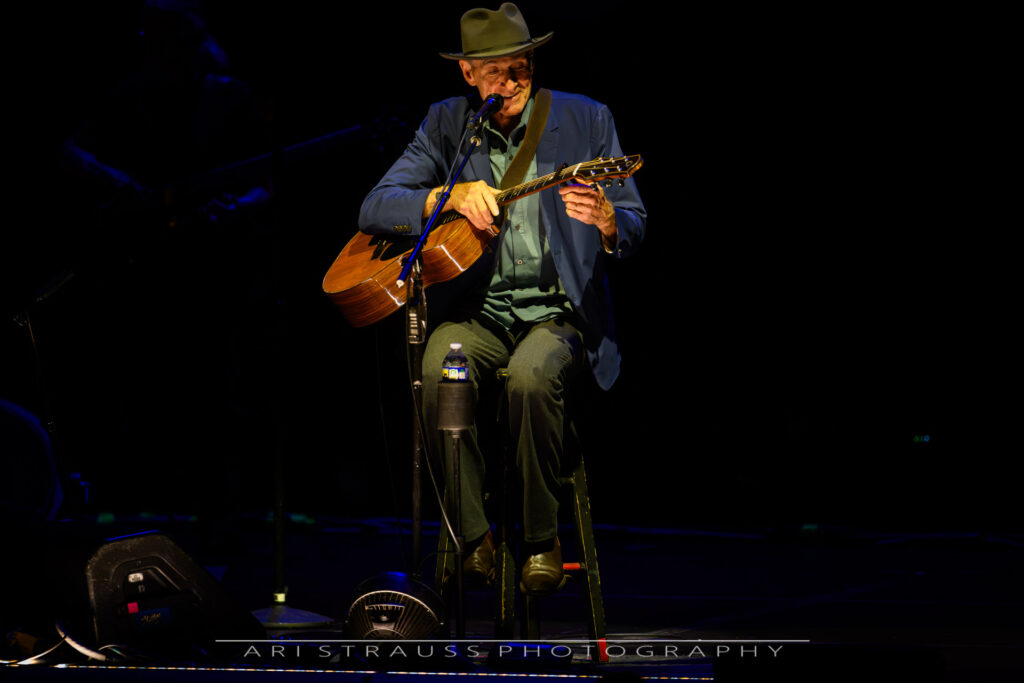
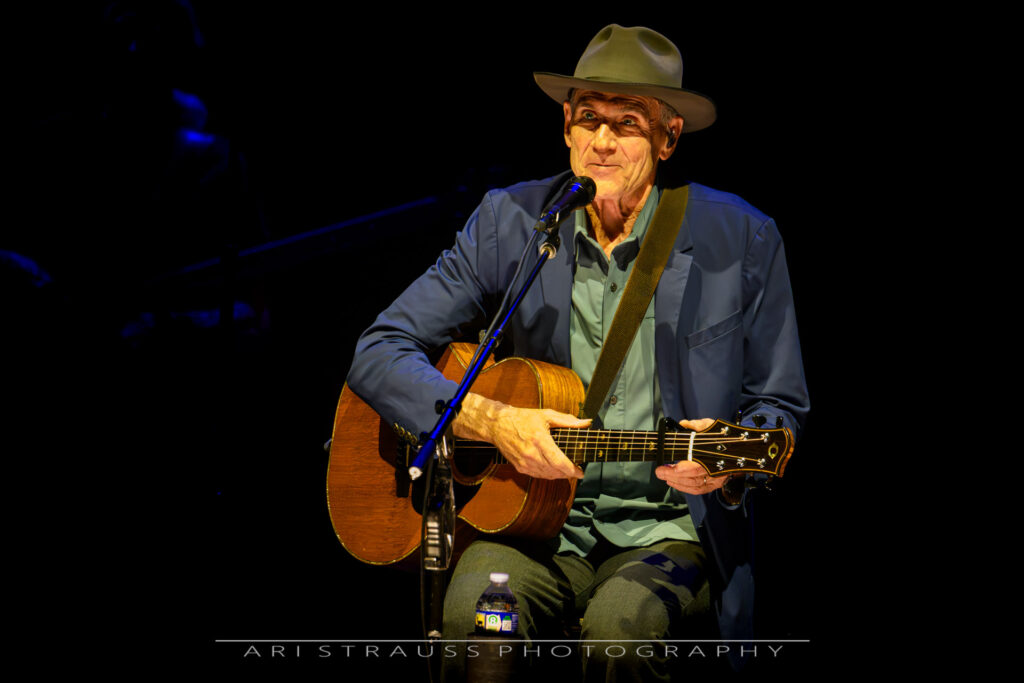
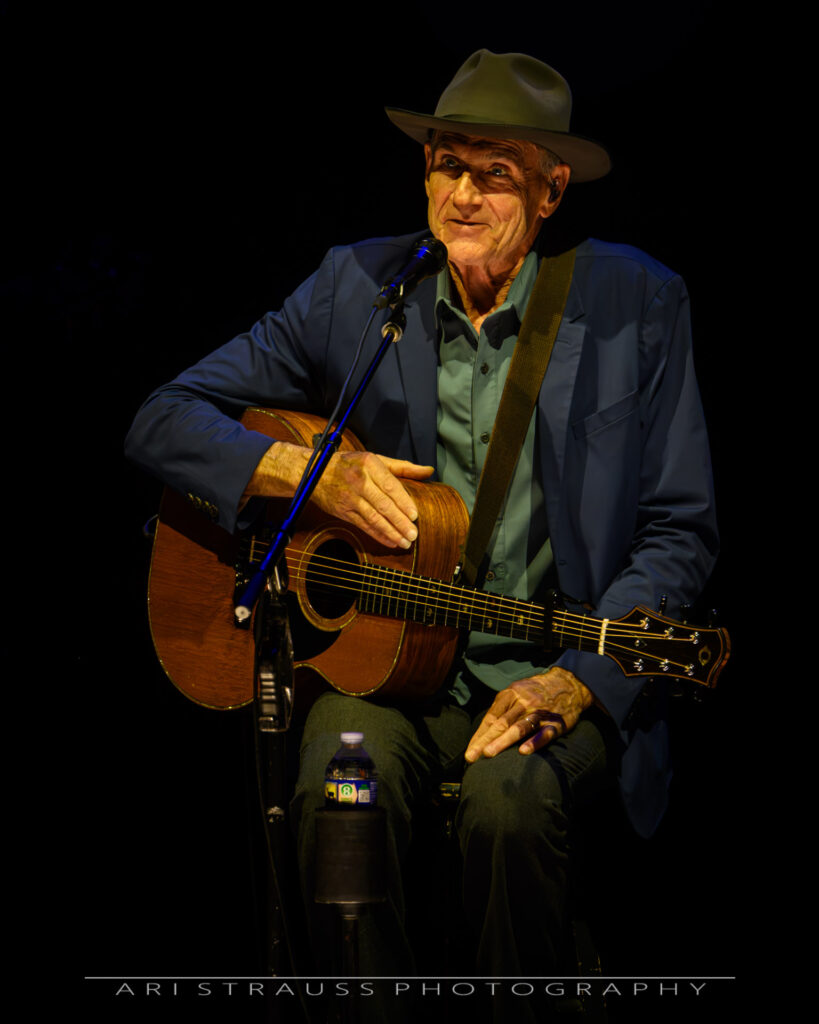
Instead, the 78-year old singer/songwriter settled onto a bar stool at center stage with an acoustic guitar and began “Whenever You’re Ready,” which turned out to be a much better clue about what Taylor had in mind for the evening.
This was my fourth consecutive year photographing and reviewing James Taylor at Wolf Trap, following appearances in 2023, 2024 and 2025. Familiarity presents a problem for the critic. There are only so many fresh ways to describe the warmth of Taylor’s voice, his dry humor, the collective sigh that accompanies “Carolina in My Mind,” or the remarkable musicianship of a touring band whose résumés could fill several pages. By year four, one either starts repeating oneself or begins looking more closely at what Taylor changes inside a concert whose broad contours remain reassuringly familiar.
Last year provided one answer. Taylor organized the early part of that show around songs of travel: wandering, walking, highways, Mexico, Carolina. This year, he announced a different theme for his opening four songs.
“Recovery.”
That single word immediately changed the way “Whenever You’re Ready,” “Rainy Day Man,” “T-Bone,” and “That’s Why I’m Here” landed. These were not simply four older songs selected from a very large pile. Taylor was using his catalog to assemble a chapter of his autobiography, revisiting the addiction and recovery that shaped his life during the 1970s and early ’80s.
Before “T-Bone,” James spoke about John Belushi, whose death in 1982 he said helped push him toward taking his own recovery seriously. Taylor had already spent years living in the orbit of heroin addiction by then. Nearly four and a half decades later, “T-Bone” was being heard through the voice of the man who survived what killed friends and contemporaries.
The distinction between the James Taylor canon and the much larger James Taylor catalog became the most interesting part of Sunday’s show. The canon is unavoidable. There are songs that would cause open revolt if omitted too often: “Fire and Rain,” “Carolina in My Mind,” “You’ve Got a Friend,” “Your Smiling Face.” They belong not only to Taylor now but to the people who have spent decades attaching weddings, deaths, road trips, breakups, graduations, and ordinary Tuesday mornings to them.
The catalog gives James more freedom.
Listen to the 1976 compilation, James Taylor’s Greatest Hits, via Spotify:
He can reach for “Whenever You’re Ready” from October Road, “T-Bone” or “Never Die Young,” pull “Line ’Em Up” out of Hourglass, or return to “Millworker,” a song that does not sound like the work of a writer merely recycling his own mythology. Those songs allow him to arrange an evening around an idea instead of marching obediently through a greatest-hits collection.
Sunday’s first set leaned heavily into that freedom.
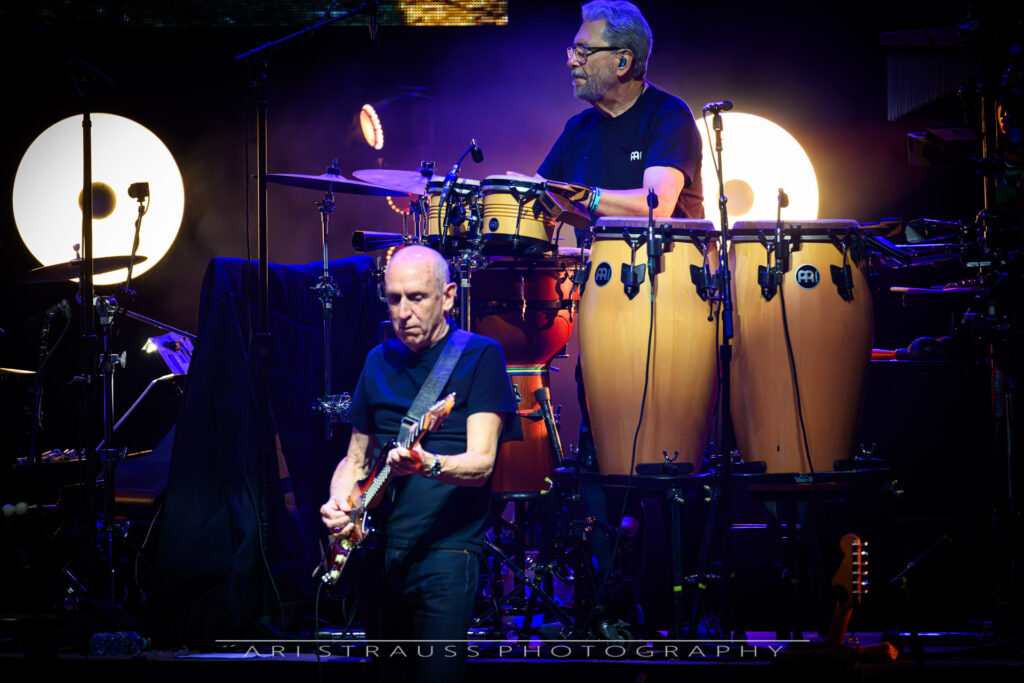
After the recovery sequence, James turned to “Mexico,” and used the occasion to introduce percussionist Luis Conte, one of several band members who received individual introductions at natural points during the night rather than as one hurried roll call. Conte’s Cuban background and command of Latin percussion made the placement feel appropriate, even if Mexico and Cuba are separated by more than a few hundred miles and quite a bit of history. The important thing was that James let the introduction emerge from the music itself.
That habit continued throughout the show. Taylor’s touring band is so absurdly accomplished that the phrase “All-Star Band” risks sounding like promotional puffery until one starts reading the names.
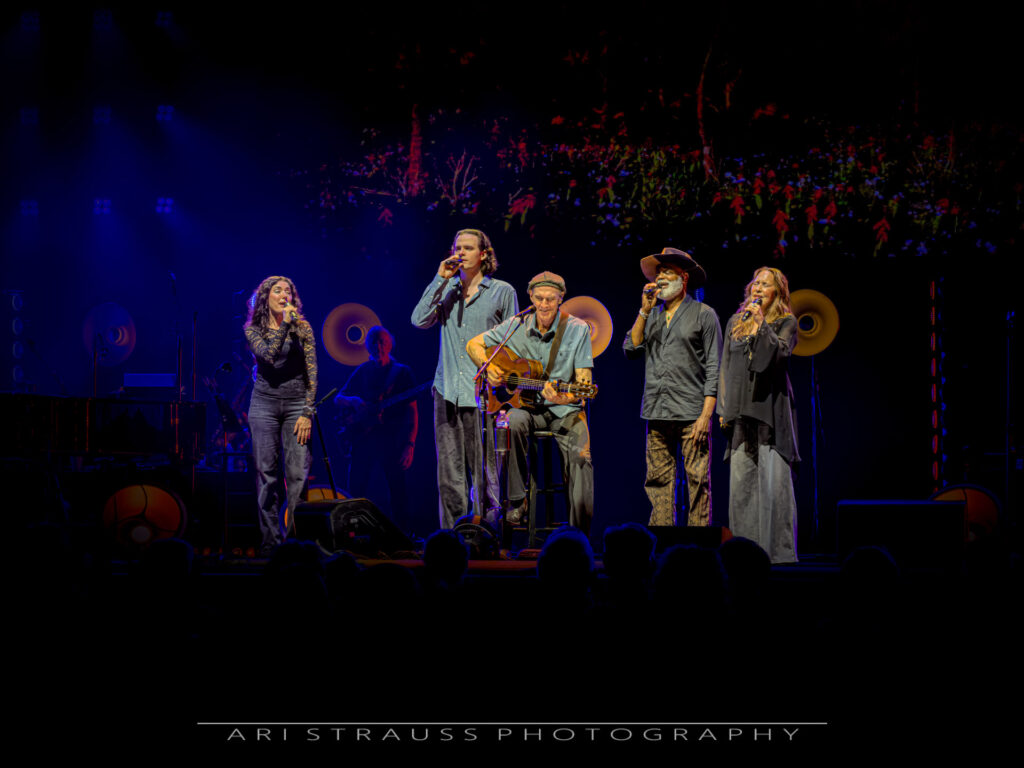
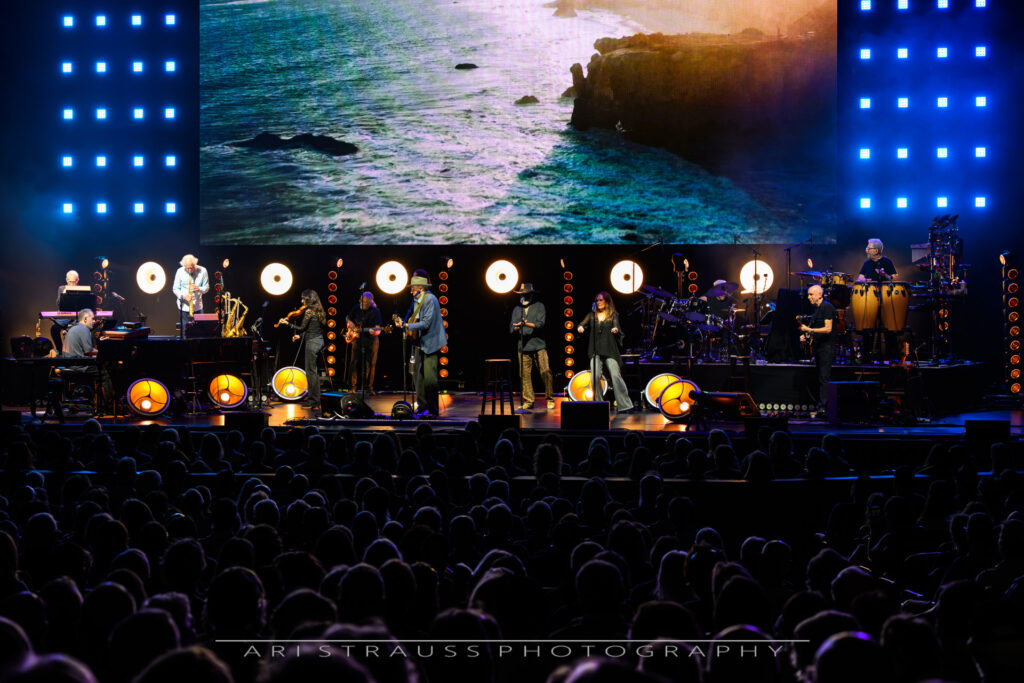
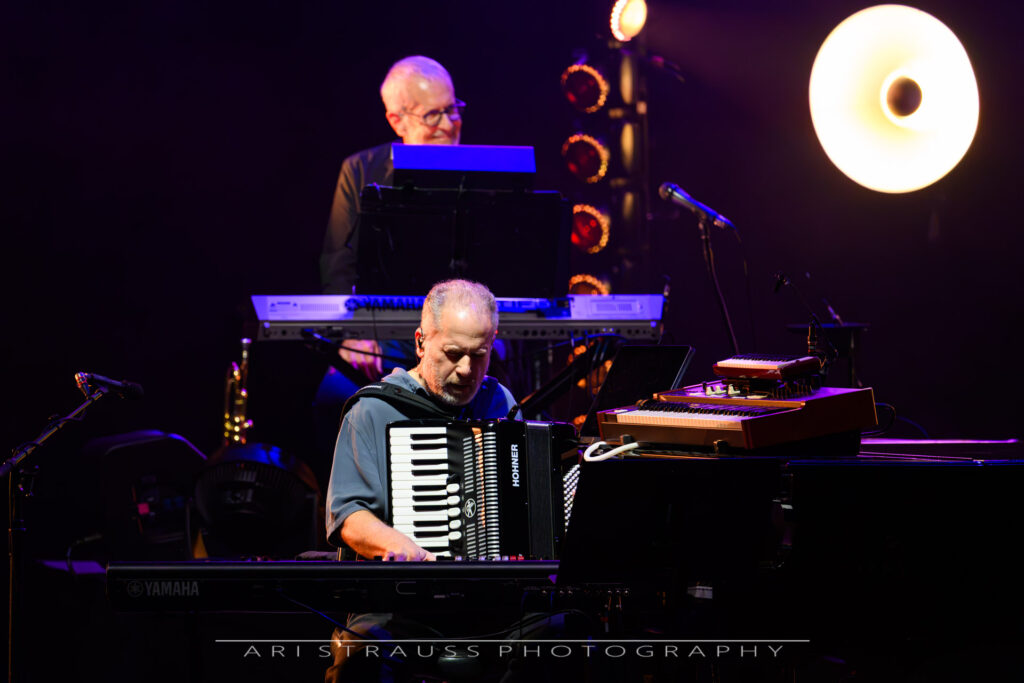
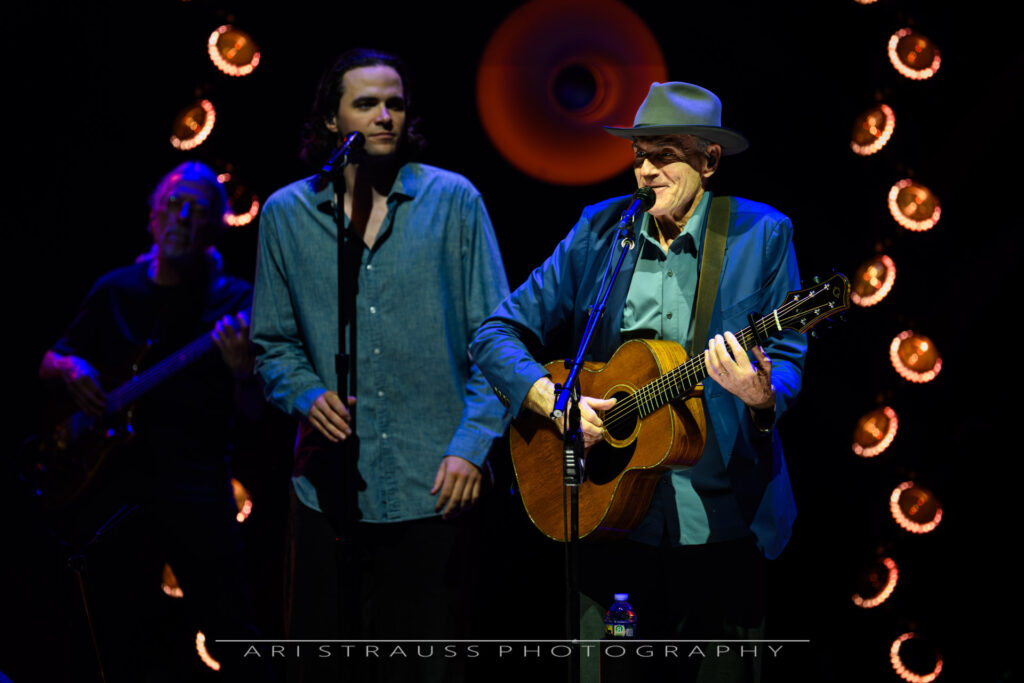
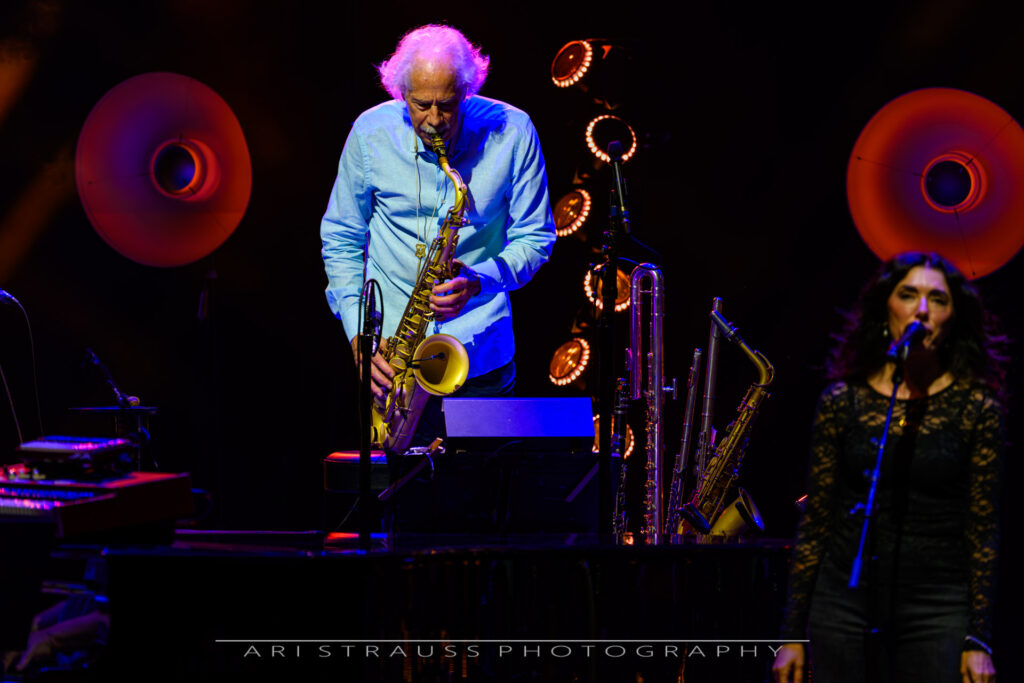
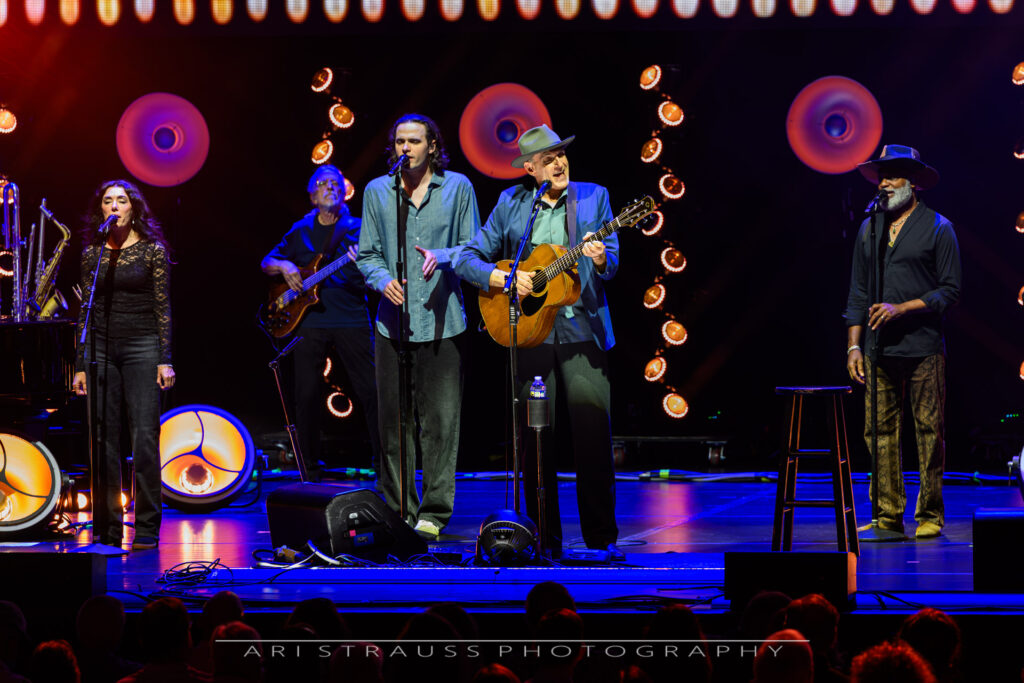
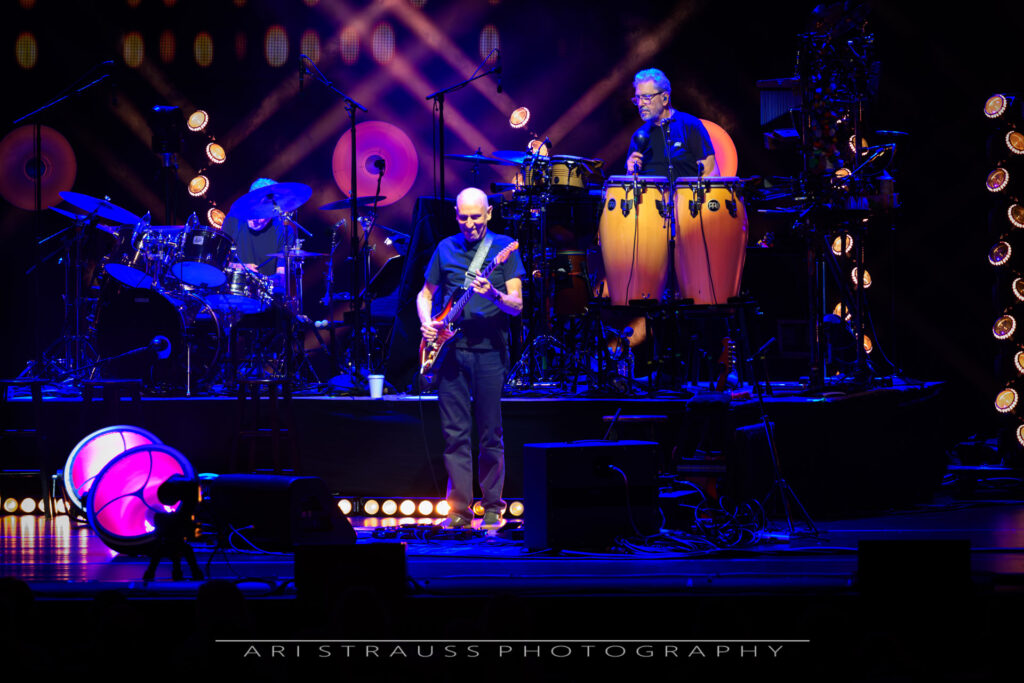
Steve Gadd was behind the drum kit. Jimmy Johnson handled bass. Michael Landau played guitar. Larry Goldings covered piano and keyboards. Luis Conte supplied percussion. Lou Marini worked the reeds. Walt Fowler added trumpet and other brass colors. Andrea Zonn contributed violin and vocals, while Kate Markowitz and Dorian Holley anchored the vocal section. Taylor’s wife, Caroline “Kim” Smedvig Taylor, and their son Henry Taylor were also prominent among the backing singers.
Any one of those musicians could command attention in another room. None behaved as though Sunday night was the place to prove it.
That may be one of Taylor’s underrated skills as a bandleader. He has surrounded himself with musicians who have spent their careers knowing exactly when to do more and, perhaps more importantly, when not to.
On “You’ve Got a Friend,” for example, the arrangement could have survived almost entirely on James’s acoustic guitar and voice. The song does not need decoration. The band therefore treated the empty spaces carefully, adding just enough bass, keyboard color, harmony and instrumental support to widen the sound without altering its center of gravity.
“Carolina in My Mind” worked similarly. The song arrived late in the second set, by which point the crowd did not require much encouragement. James’s fingerstyle guitar established the emotional frame. Johnson’s bass and the rest of the band lived around it rather than stepping on top of it. The effect was less about building a wall of sound than preventing the song from feeling small inside the Filene Center.
Other songs demanded more.
“Shower the People” gave the singers and rhythm section considerably more room, particularly when James introduced it with a brief statement that carried more weight than the usual between-song pleasantry.
“It doesn’t matter what your world view is,” he said. “Every time you encounter another human being, you have an opportunity to make the world a better place.”
The song then expanded outward, with Dorian Holley taking a prominent featured vocal and turning the final portion into something closer to gospel testimony than introspective singer-songwriter fare. Holley did not grab the spotlight so much as receive it from James, who seemed perfectly content to let one of the best singers on his stage take over for a while.
That willingness to redistribute attention showed up repeatedly. Taylor’s name may be on the ticket, but his live arrangements are built around the understanding that these songs have other voices available to them.
“Line ’Em Up” provided the night’s sharpest Washington-area moment.
James explained that he wrote the song after recalling the final days of Richard Nixon’s presidency. When Nixon resigned and prepared to leave the White House aboard Marine One, members of the staff were lined along his route from the building to the helicopter, each getting a last handshake or goodbye. That image became the seed for “Line ’Em Up.”
Taylor paused after recounting it.
“I never dreamed I’d say this,” he said, “but I fucking miss Richard Nixon.”
The implication did not require elaboration.
At a venue just outside Washington, the line landed immediately. Taylor moved on rather than turning the concert into a political monologue. The song itself had already done the work, carrying a memory of one disgraced presidency into a joke about the present one.
“Millworker” pulled the catalog in another direction.
The song was written for the Broadway musical Working, inspired by Studs Terkel’s landmark oral history of American workers. Taylor explained how he had been commissioned to contribute to the production, which required him to step outside the autobiographical mode most listeners associate with him. “Millworker” is written from the perspective of a woman whose life has narrowed into factory labor, family responsibility and memory.
It remains one of the useful correctives to the shorthand version of James Taylor as a man who mostly writes about James Taylor.
Then there was “Steamroller.”
Taylor has been playing the song for more than half a century, yet it still benefits from understanding the joke. “Steamroller” is not James earnestly trying to prove his blues credentials. It is James Taylor making fun of white blues singers trying much too hard to prove their blues credentials.
Sunday night, he committed to the bit.
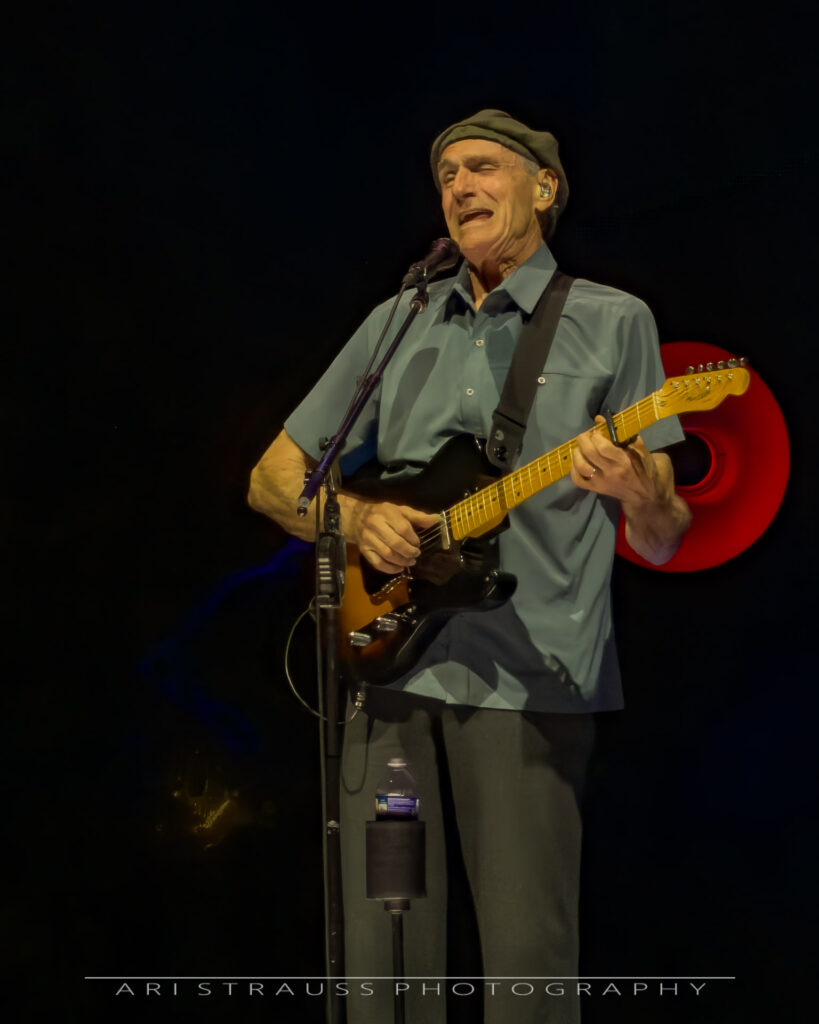
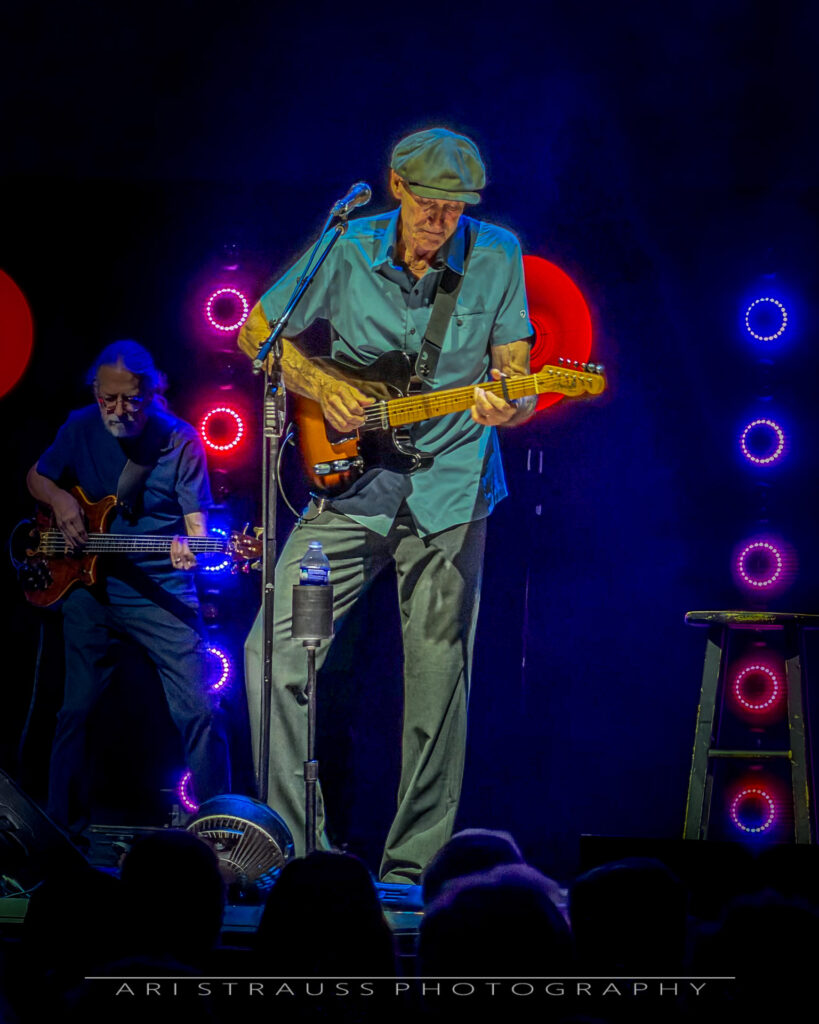
The acoustic guitar disappeared and out came a sunburst Fender Telecaster with a black pickguard. Taylor leaned into exaggerated blues phrasing while the band supplied the kind of oversized accompaniment the parody requires. For a musician whose public image is tied so closely to sensitive acoustic music, there is still something funny about seeing him strapped into a Telecaster and deliberately overplaying the role.
The song also demonstrated what the band could do when invited forward. Gadd, Johnson, Landau, Goldings, Conte and the horns were no longer filling spaces around Taylor. They were creating the spaces for him to stomp through.
After intermission came the first significant departure from the setlist Taylor had been using during recent shows.
Instead of opening Set 2 with Buddy Holly’s “Everyday,” as he has at several recent shows on this tour, James played “Country Road,” one of several hits from his 1970 album, Sweet Baby James.
Stream the 2019 remaster of Sweat Baby James by James Taylor on Spotify:
That swap seemed minor at first. By the end of the night, it looked like part of a pattern.
“Copperline” followed. James introduced it as another song rooted in North Carolina and spoke about writing it with the late novelist and poet Reynolds Price. His description of the song was memorable: a song version of a landscape painting.
That is almost exactly how “Copperline” behaves. “Carolina in My Mind” is the state reduced to a universal emotional destination. “Copperline” is more granular. It remembers geography, childhood detail and place with the specificity of someone trying to rebuild scenery that no longer exists exactly as it did in memory.
Two Carole King songs came next, “You’ve Got a Friend” and “Up on the Roof.”
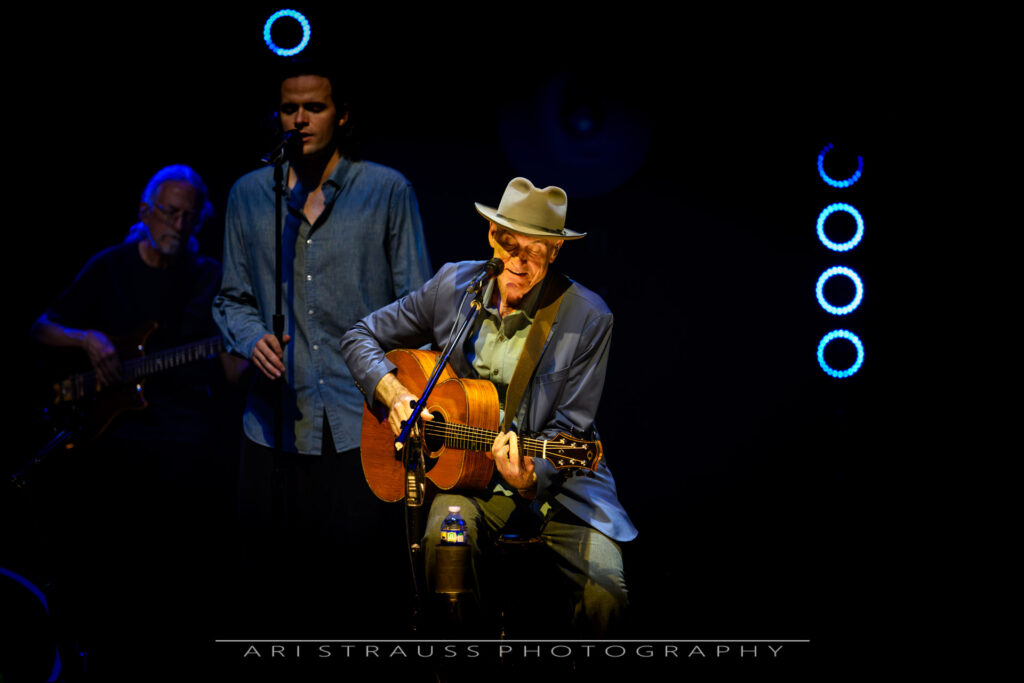
In the time since I last reviewed a James Taylor concert, I’ve become somewhat of a guitarphile. I noticed a smaller detail that became interesting to me: James used two different Olson acoustic guitars for the two Carol King songs. “You’ve Got a Friend” was played on a cutaway Olson SJ, while he switched to a non-cutaway SJ for “Up on the Roof.” The two instruments sounded different enough to make the change more than cosmetic. The cutaway had a little more immediacy and note definition to my ear; the non-cutaway sounded fuller and rounder.
Taylor has spent decades developing a fingerstyle approach in which the guitar is not simply accompanying the vocal. Bass movement, internal harmony and rhythm are all embedded in what his right hand is doing. Once you start watching those hands rather than merely listening to the famous voice above them, the instrument changes become easier to understand. Different acoustic guitars give him different colors, even within consecutive songs written by the same songwriter.
Watch James Taylor give a tour and explanation of his guitar collection in this video on YouTube:
Then came another setlist surprise.
Where “Sweet Baby James” had been appearing in recent shows, Taylor played “Never Die Young.”
“Sweet Baby James” is one of the load-bearing songs in the entire Taylor canon. A concert can survive without it, obviously, but dropping it in favor of “Never Die Young” was a conspicuous decision to let the catalog displace one of the expected monuments.
The idea that Taylor might be spreading material across his three-night Wolf Trap stand was impossible to confirm Sunday. He was scheduled to return September 1 and 2, and only those subsequent setlists would reveal whether night one represented ordinary tour variation or a conscious attempt to reward repeat attendees with different combinations. Either way, this was no longer a rigid reproduction of the recent European set.
“Carolina in My Mind” and “Fire and Rain” followed, and the canon reasserted itself.
Those are the songs Taylor no longer has to introduce in any meaningful sense. The first guitar figure is enough. Decades of recognition do the rest.
“Fire and Rain,” in particular, benefited from a more present backing arrangement than the restrained treatment given to “You’ve Got a Friend.” The band was still disciplined, but there was more weight behind James. Gadd’s drums mattered. Johnson’s bass mattered. The surrounding voices and instrumental textures made the song feel larger without turning it bombastic.
That distinction kept recurring throughout the night. Taylor’s band did not have one default setting.
“Your Smiling Face” wanted movement, so it received it. The rhythm section pushed harder, the vocals sat higher in the mix, and the song carried the buoyancy of a record that still sounds built for motion.
“Shower the People” needed the ensemble.
“Steamroller” needed practically everybody.
“Fire and Rain” needed support without intrusion.
“You’ve Got a Friend” mostly needed James Taylor, with ten excellent musicians knowing enough to leave room around him.
That is the luxury of employing people this good. Taylor does not need to police a stage full of musicians waiting for their turn to demonstrate why they were hired. They already know why they were hired.
The encore brought “Shed a Little Light,” followed by Marvin Gaye’s “How Sweet It Is (To Be Loved by You),” another cover so deeply absorbed into Taylor’s live identity that calling it a cover almost feels academic.
The final change came at the very end.
Instead of the expected “You Can Close Your Eyes,” James finished with “Secret o’ Life.”
It was one last choice from the catalog over a more predictable closer.
By then, the shape of the evening had become clear enough. Taylor still has a canon that exerts tremendous gravitational pull. “Carolina,” “Fire and Rain,” “You’ve Got a Friend,” and “Your Smiling Face” are going to occupy substantial real estate because thousands of people have paid to hear them.
What Taylor can still change, and apparently enjoys changing, is the road between those landmarks.
On Sunday, that road began with recovery. It passed through Nixon’s resignation, a millworker imagined through Studs Terkel’s America, a parody bluesman with a Telecaster, Reynolds Price’s North Carolina and several songs whose presence displaced safer choices.
After four consecutive summers watching Taylor at Wolf Trap, that may be the useful distinction. The famous songs tell us who James Taylor has been to everyone else. The rest of the catalog lets him decide who he wants to be on a particular night.
Setlist
Set 1
- Whenever You’re Ready
- Rainy Day Man
- T-Bone
- That’s Why I’m Here
- Mexico
- Line ’Em Up
- Millworker
- Shower the People
- Handy Man
- Steamroller
Set 2
- Country Road
- Copperline
- You’ve Got a Friend
- Up on the Roof
- Never Die Young
- Carolina in My Mind
- Fire and Rain
- Your Smiling Face
Encore
- Shed a Little Light
- How Sweet It Is (To Be Loved by You)
- Secret o’ Life
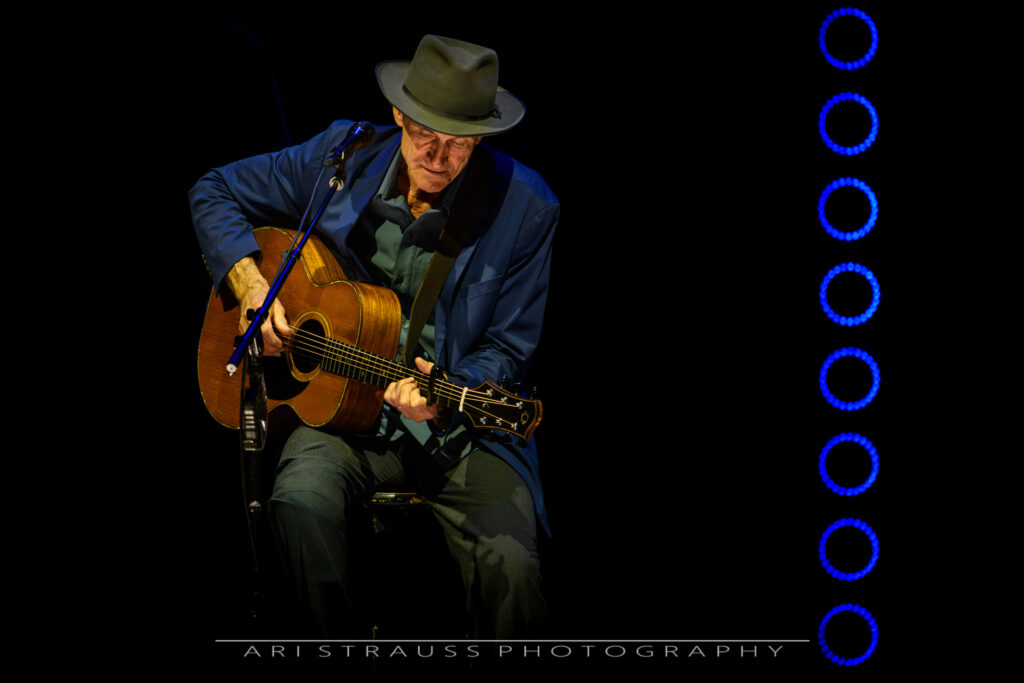
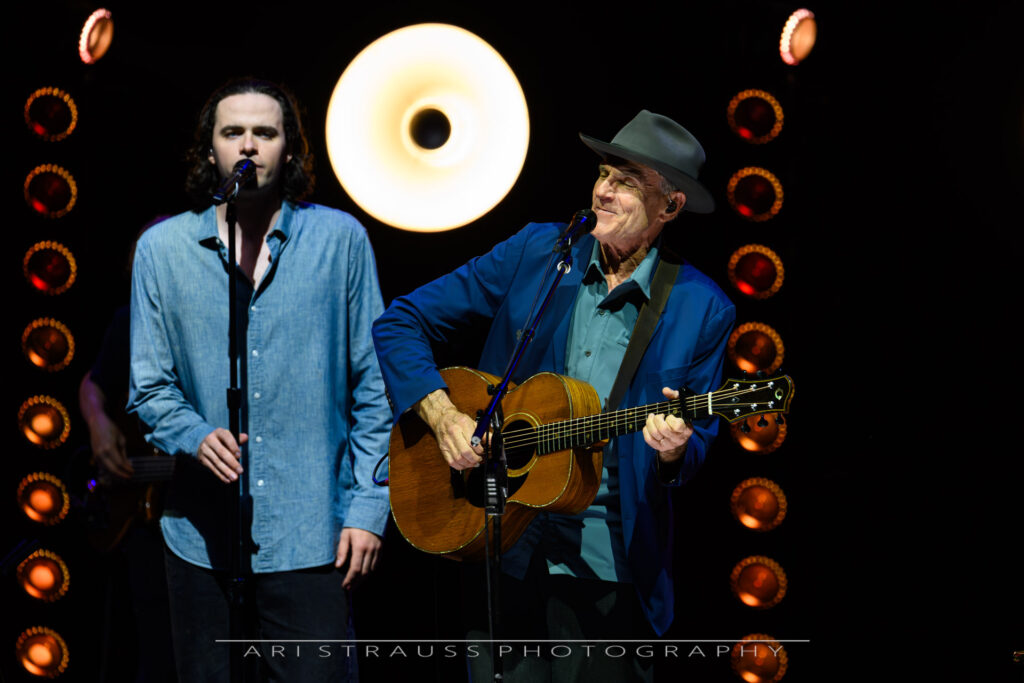
Enjoy some additional photos from James Taylor and his Allstar Band performance at Wolf Trap on August 30, 2026. All images are copyrighted and courtesy of Ari Strauss.








Great review and photos. We’ve gone each year as well to see JT. Set list seemed the same tonight as yours but Kim was not part of Wednesday’s show. I completely missed Sweet Baby James until you pointed that out. Maybe next year!
Well written article and great photos Ari. Just incredible and two could clearly be album covers. I hope James can see these. We went to the 1 September Tuesday show and it was fantastic. JT never disappoints and he hung out with some fans after the show. Ushers at Wolf Trap and sound crew were excellent. It was nice to see his son Henry and wife Kim on vocals. And nothing to take away from Kate and Dorian, just incredibly talented vocalists. And Lou Marini delivers always. I did miss my favorite “You can close my eyes” but James has many hits, we will enjoy no matter what. We lost Jim Croce and John Denver far too early but like Jimmy Buffet we can enjoy James’ lifetime body of work for a long time. And we are privileged to see him perform again and again.