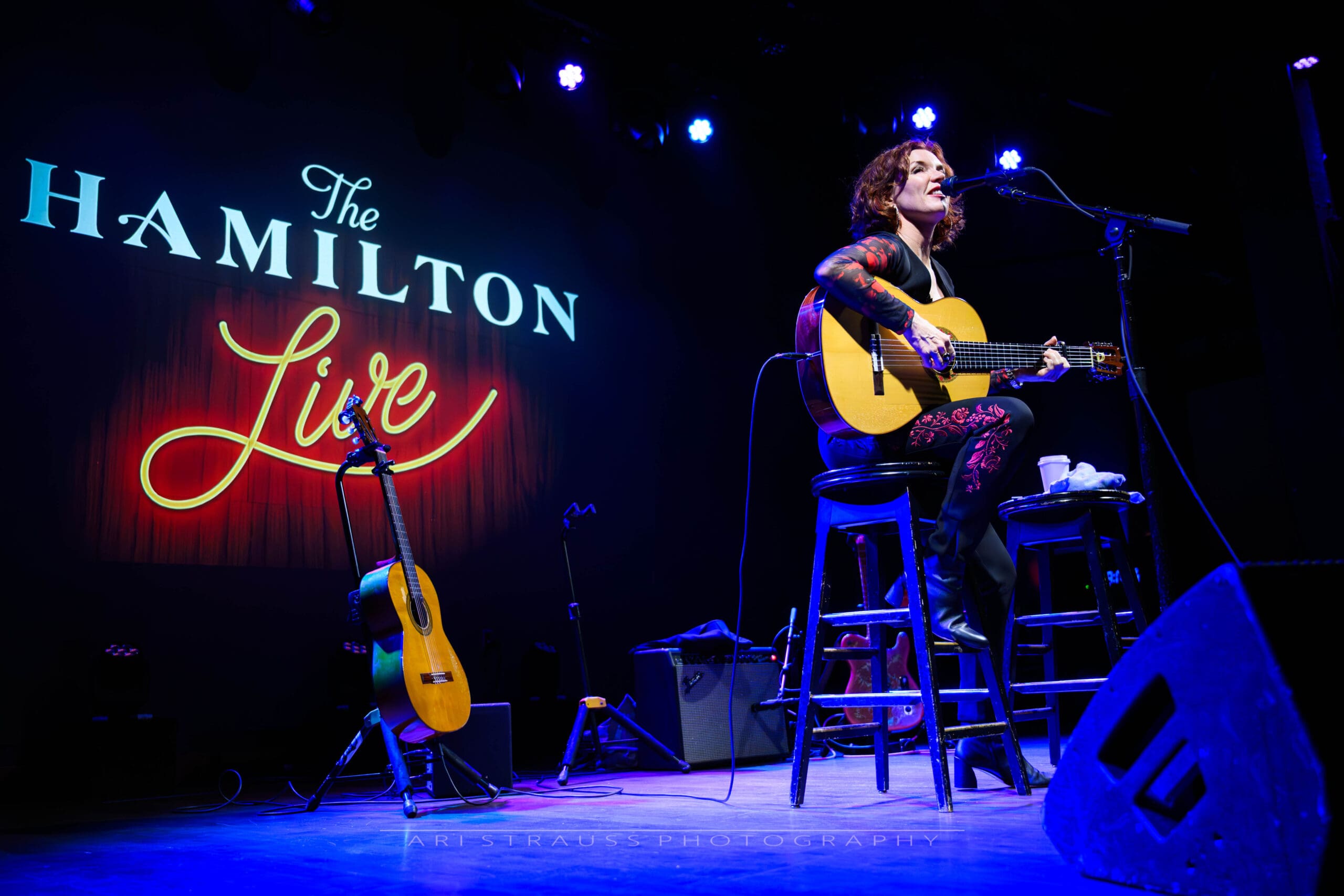
In addition to being one of the most celebrated blues artists of her generation, Ottawa, Ontario native Sue Foley is a scholar. On Wednesday evening, she brought dazzling guitar chops and a fun dose of music history in her One Guitar Woman: A Tribute to the Female Pioneers of Guitar show at The Hamilton Live.
Her set began with female blues pioneer Memphis Minnie’s “Nothin’ in Ramblin’.” “I discovered Minnie when I was 16,” when she decided to become a blues guitarist. Minnie, Sue explained, passed away in obscurity in 1973. All her songs are attributed to her husband, “but I have a hard time believing a man wrote this song,” she said, introducing “In My Girlish Days.”
From there, Foley moved on to Elvie Thomas. Only six songs, recorded in 1930, exist from this artist, including “Motherless Child Blue.” Sue brought up a New York Times piece, “The Ballad of Geeshie and Elvie,” which delves into the mystery surrounding this artist. She also talked about visiting the history museum and seeing the archive of Mac McCormick, who is the only person to have interviewed Elvie.
Much mystery surrounds this pair of woman. Geeshie — which was a nickname — was on the run, possibly for having killed her husband. Little survives of her work, among that “Last Kind Word Blues.”
Watch Sue Foley perform “Last Kind Words Blues” by Geeshie Wiley live on YouTube:
The next character in this story, Elizabeth Cotten, an exemplar of the Piedmont style, is more well-known. Cotten got off to a late start in her career, recording her first album at the age of 57, and winning a Grammy at 90. She was discovered, so to speak, when she was working as a housekeeper for the musical Seeger family. Sue played two of her songs, “Babe, It Ain’t No Lie” and “Freight Train.”
Foley moved from blues to country with Mother Maybelle Carter, who is “part of the fabric of American music and culture.” As part of the Carter family, Maybelle was there for the recording session with Ralph Peer in Bristol, Tennessee, that’s referred as to the Big Bang of Country Music. Her “Carter Scratch” method has influenced generations of guitarists. Sue played her tribute to her, “Maybelle’s Guitar,” as well as a Carter Family classic, “Lonesick Homesick Blues.” Foley noted that the song is challenging because it involves flatpicking in an open tuning.
Sister Rosetta Tharpe is now widely hailed as a precursor to rock & roll, but, as Sue noted, she also had a softer, more contemplative side, exemplified in “My Journey to the Sky.” Foley mentioned that Gayl Wald, who wrote the biography of Tharpe, was in attendance.
Demonstrating her ability to play just about any style of music, Sue did Tejano musician Lydia Mendoza’s “Mal Hombre.” Mendoza, whose parents came from Monterrey, Mexico, was born in Houston, and the family worked as agricultural laborers. Mendoza wrote the song from the perspective of a young woman being led astray; Foley said she approaches from the perspective of looking back on those younger days.
The show came full circle with “Maleguena,” a piece by the first woman Foley say play guitar, Charro. Sue mentioned she has a book coming out in May, Guitar Women, made up of interviews with prominent female guitarists, including Bonnie Raitt, Lita Ford, and Suzi Quattro. For her encore, Foley strapped on her trademark electric guitar, Pinkie, and rocked the house with “Hurricane Girl.”
Scott Tournet, formerly a member of the Nocturnals with Grace Potter, opened the show. He kicked things off with “2:22,” which he described as “a dirty little blues that I wrote quote a few years ago.” The song, written with Potter, was originally from a woman’s perspective, but he’s changed it up.
Introducing the next song, he said something I can relate to, that with getting older sometimes you just woke up at 4am. That he inspired him to write a song about getting out of bed and going for a walk. The set continued with “Lonely Road,” followed by a song about not wanting to play “those 500 [cover] songs” he was given a list of by a band he tried out for in Nashville. He played the title track from his most recent album, “Home,” and finished with “Medicine,” which was influenced by JJ Cale. T-Bone Burnett had a hand in it, changing it from a major to a minor key.
Watch the official music video for “Lonely Road” by Scott Tournet on YouTube:
Scott’s songs were well chosen for the evening and the audience, and they were a nice compliment to Foley. As a nerd, this was my kind of show, combining great music with forays into history and culture. The blues may, as Foley said, her “comfort zone,” but her playing was spectacular in all the types of music she played. I can’t recommend highly enough checking out her live shows, and you should check out her forthcoming book in May.
Here are some photos of Sue Foley performing live at The Hamilton Live on March 11, 2026. All pictures copyright and courtesy of Ari Strauss.